
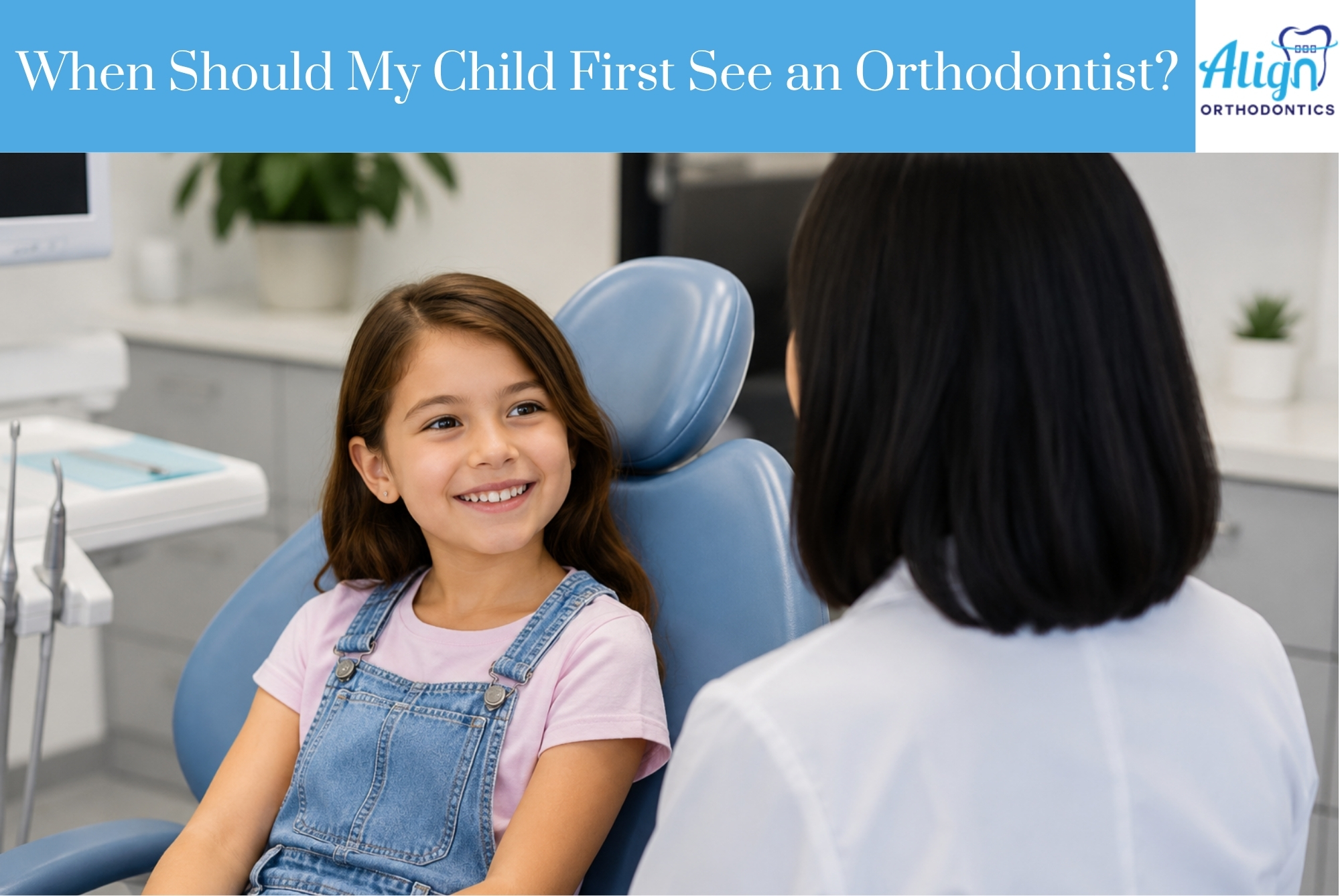
As a parent, you may wonder when your child should first see an orthodontist—especially if their permanent teeth are still coming in or their smile appears relatively straight. While orthodontic treatment does not necessarily begin at a young age, an early orthodontic evaluation can provide valuable insight into how your child’s teeth, jaws, and bite are developing.
A commonly recommended milestone for a child’s first orthodontic evaluation is around age 7. At this age, children typically have a combination of primary (baby) teeth and permanent teeth, giving an orthodontist an opportunity to evaluate dental development, jaw growth, tooth eruption, and bite relationships.
At Align Orthodontics Lexington, orthodontic evaluations help families in Lexington, Massachusetts, better understand their child’s developing smile. An early visit does not automatically mean braces or another orthodontic appliance will be recommended. In many cases, the appropriate approach is simply to monitor growth and development until treatment would provide the greatest benefit.
Why Is Age 7 an Important Time for an Orthodontic Evaluation?
Around age 7, many children have entered what dental professionals call the mixed-dentition stage. This means that both primary and permanent teeth are present.
The first permanent molars and incisors have often erupted by this age. Their positions can provide useful information about how the upper and lower teeth fit together and whether sufficient space appears to be available for additional permanent teeth.
An orthodontist can evaluate more than whether teeth look straight. The examination may include the child’s bite, jaw relationships, eruption patterns, available dental space, tooth alignment, facial growth, and symmetry.
Some orthodontic concerns are easier to recognize once these permanent teeth begin appearing, even though the child may still be several years away from comprehensive orthodontic treatment.
Does My 7-Year-Old Need Braces?
Not necessarily. An orthodontic evaluation at age 7 should not be confused with automatically starting braces at age 7.
Many children who receive an early orthodontic evaluation will not require immediate treatment. Instead, the orthodontist may recommend periodic observation as the permanent teeth erupt and the jaws continue growing.
Monitoring can be valuable because it allows an orthodontist to identify changes over time and recommend treatment when the child’s stage of dental and facial development is appropriate.
For some children, however, an early evaluation identifies a specific developmental or bite problem that may benefit from intervention before all permanent teeth have erupted.
What Does an Orthodontist Look for During an Early Evaluation?
An orthodontic examination considers the relationship between the teeth, jaws, bite, and facial development rather than focusing solely on individual crooked teeth.
An orthodontist may evaluate whether the upper and lower jaws are developing proportionately, whether the bite closes appropriately, whether permanent teeth appear to have enough room to erupt, and whether emerging teeth are following expected eruption patterns.
The evaluation can also identify conditions such as crossbites, underbites, excessive overjet, crowding, spacing, open bites, missing teeth, unusually positioned teeth, or other developmental concerns.
Identifying these characteristics early gives parents a clearer understanding of their child’s orthodontic development and whether observation or treatment may be appropriate.
What Is Early or Phase 1 Orthodontic Treatment?
Early orthodontic treatment is sometimes called interceptive orthodontics or Phase 1 treatment. It is performed while a child still has some primary teeth and is generally recommended only when there is a specific reason to intervene during growth.
The objective of Phase 1 treatment depends on the child’s individual diagnosis. Treatment may be considered to address certain bite relationships, guide dental or jaw development, create or preserve space for developing permanent teeth, or manage other orthodontic concerns.
After Phase 1 treatment, there is often a period of observation while additional permanent teeth erupt. Some children may later need comprehensive treatment, sometimes called Phase 2 treatment.
Because every child’s growth and dental development are different, an orthodontic examination is necessary to determine whether early treatment offers a meaningful benefit.
What Orthodontic Problems May Be Easier to Address Early?
Certain orthodontic conditions can benefit from being identified while a child is still growing. Examples may include some crossbites, significant crowding, abnormal eruption patterns, pronounced jaw discrepancies, and bite problems that affect normal oral function.
Timing matters because the teeth and jaws change considerably throughout childhood and adolescence. Depending on the diagnosis, an orthodontist may be able to use growth and development as part of the treatment strategy.
This does not mean that every orthodontic problem should be treated early. Appropriate orthodontic care involves determining both whether treatment is needed and when it should begin.
What Is a Crossbite?
A crossbite occurs when one or more upper teeth bite inside the corresponding lower teeth rather than outside them.
Crossbites can involve the front or back teeth and may have dental or skeletal components. Because the jaws are still developing during childhood, an orthodontist may recommend monitoring or treating certain crossbites at an earlier age.
The appropriate approach depends on the type and severity of the crossbite and the child’s stage of development.
What Is an Underbite?
An underbite generally describes a bite relationship in which the lower front teeth sit ahead of the upper front teeth when the mouth is closed.
An underbite can be associated with tooth position, jaw development, or a combination of both. Because growth can influence this relationship, early evaluation allows an orthodontist to assess the condition and determine whether treatment, monitoring, or future intervention is appropriate.
What Is an Overbite, and Is It the Same as Overjet?
Although the terms are sometimes used interchangeably in everyday conversation, overbite and overjet describe different relationships.
Overbite generally refers to the vertical overlap of the upper and lower front teeth. Overjet refers to the horizontal distance between the upper and lower front teeth.
A certain amount of overlap can be normal. An orthodontist evaluates the degree of overbite or overjet, the child’s facial and jaw development, and other aspects of the bite before determining whether treatment is necessary.
What Is Dental Crowding?
Dental crowding occurs when there is insufficient space for teeth to align normally within the dental arches.
Parents may notice teeth overlapping, rotating, or erupting outside the expected position. In younger children, an orthodontist can evaluate the available space as well as the position and development of permanent teeth that have not yet erupted.
Crowding can vary considerably in severity, so its presence alone does not determine when treatment should begin.
Should My Child See an Orthodontist If Their Teeth Look Straight?
Yes, an orthodontic evaluation can still be worthwhile even when a child’s visible teeth appear straight.
Some bite and jaw-development concerns are not immediately obvious when looking at a smile. Teeth can appear relatively well aligned while the upper and lower jaws do not fit together ideally, or permanent teeth developing beneath the gums may have limited eruption space.
An orthodontic evaluation considers these less visible aspects of dental development.
Should My Child See an Orthodontist Before All Permanent Teeth Come In?
An initial orthodontic evaluation can take place well before all permanent teeth have erupted.
Waiting for every permanent tooth to emerge may not be necessary for identifying bite, eruption, space, or jaw-development concerns. An early evaluation can establish a baseline and allow the orthodontist to monitor changes as the child’s permanent teeth emerge.
If no treatment is currently necessary, observation may be recommended.
Signs Your Child May Benefit From an Orthodontic Evaluation
Parents do not need to diagnose orthodontic conditions themselves. However, certain observations may be good reasons to schedule an evaluation.
These can include visibly crowded or overlapping teeth, substantial spaces between teeth, difficulty biting or chewing, an upper or lower jaw that appears unusually prominent, teeth that do not meet normally, early or delayed loss of primary teeth, permanent teeth erupting in unexpected positions, or a bite that appears uneven.
Persistent oral habits or unusual jaw movements can also be worth discussing with an orthodontist.
A professional evaluation is the appropriate way to determine whether these observations represent an orthodontic concern.
What Happens at a Child’s First Orthodontic Appointment?
The purpose of an initial orthodontic appointment is to understand the child’s current dental and facial development.
The orthodontist will generally examine the teeth, bite, and jaw relationships. Depending on the practice and the child’s needs, diagnostic records such as photographs or radiographic imaging may be recommended.
Parents can also discuss concerns they have noticed at home and ask questions about tooth eruption, bite development, treatment timing, and future orthodontic needs.
After evaluating the child, the orthodontist can explain whether treatment is recommended now, whether monitoring is more appropriate, or whether no orthodontic intervention is currently necessary.
Why Might an Orthodontist Recommend Monitoring Instead of Treatment?
Orthodontic treatment is most effective when it is appropriately timed.
If a child’s teeth and jaws are developing normally—or if an existing concern would be better addressed at a later developmental stage—the orthodontist may recommend observation rather than immediate treatment.
During an observation period, the orthodontist can follow the eruption of permanent teeth and changes in the bite and jaw relationships. This approach can help identify an appropriate treatment window without starting treatment unnecessarily early.
Is Early Orthodontic Treatment Better Than Waiting?
Early treatment is not inherently better for every child.
The value of treatment depends on the specific orthodontic diagnosis, the child’s dental development, growth pattern, and other individual factors. Some conditions may benefit from early intervention, while others may be treated more efficiently after additional permanent teeth have erupted.
This is one reason an early evaluation can be helpful: it allows an orthodontist to distinguish between conditions that may benefit from treatment now and those that are better monitored.
When Do Children Usually Get Braces?
There is no single age at which every child should receive braces.
Comprehensive orthodontic treatment commonly occurs after many or most permanent teeth have erupted, often during the preteen or teenage years. However, individual treatment timing can vary considerably.
Dental age and skeletal development can be more relevant than chronological age alone. Two children of the same age can be at very different stages of tooth eruption and jaw growth.
An orthodontist can determine an appropriate treatment timeline based on the child’s individual development.
Can Early Orthodontic Evaluation Prevent Future Problems?
An early evaluation cannot guarantee that a child will avoid future orthodontic treatment. It can, however, identify developing concerns and provide an opportunity to monitor them appropriately.
When a condition is suitable for early intervention, timely treatment may influence how that specific problem develops. When intervention is unnecessary, monitoring allows treatment to be postponed until a more appropriate stage.
The principal benefit of early evaluation is therefore informed treatment planning rather than automatically beginning treatment sooner.
How Does Jaw Growth Affect Orthodontic Treatment?
The upper and lower jaws continue developing throughout childhood and adolescence. Their size, position, and relationship play an important role in the bite and overall facial structure.
Some orthodontic problems primarily involve tooth position, while others involve skeletal relationships between the jaws. Many involve elements of both.
Because growth can affect treatment planning, evaluating a child before growth is complete can provide useful diagnostic information and help an orthodontist determine appropriate timing.
Why Is Tooth Eruption Important in Orthodontics?
Permanent teeth develop beneath the gums before they become visible in the mouth. Their position and eruption path can influence future alignment.
During an orthodontic evaluation, the doctor may assess which permanent teeth have erupted, which remain developing, and whether there appears to be adequate space for them.
Unusual eruption patterns do not always require immediate treatment, but identifying them can allow appropriate monitoring and planning.
Is an Orthodontist Different From a General Dentist?
Dentists and orthodontists both play important roles in children’s oral health, but their areas of focus differ.
A general or pediatric dentist typically focuses on overall oral health, including preventive care, cleanings, tooth decay, gum health, and routine dental development.
An orthodontist is a dentist who has completed additional specialized education focused on diagnosing, preventing, and treating problems involving tooth alignment and bite and jaw relationships.
Children should continue regular dental care even while receiving orthodontic evaluations or treatment.
Do I Need a Referral to Schedule an Orthodontic Evaluation?
Families often contact orthodontic practices directly for an evaluation, although referral procedures can vary depending on the practice and insurance plan.
If you are unsure whether a referral is required, you can contact Align Orthodontics Lexington or check with your dental insurance provider before scheduling.
Preparing Your Child for Their First Orthodontic Visit
A first orthodontic appointment does not need to feel intimidating. Parents can explain that the orthodontist will look at how the teeth and jaws are growing and answer questions about the child’s smile.
Avoid promising that the child will or will not need braces before the evaluation. Instead, present the appointment as an opportunity to learn about their dental development.
If you have noticed specific concerns—such as difficulty biting, unusual tooth eruption, crowding, or changes in the child’s bite—consider mentioning them during the appointment.
Why Families in Lexington, MA Should Consider an Early Orthodontic Evaluation
For families in Lexington and surrounding Massachusetts communities, an orthodontic evaluation around age 7 can provide a useful baseline for understanding a child’s developing teeth, bite, and jaws.
The evaluation does not commit a family to treatment. Instead, it can help answer important questions: Is development progressing normally? Is there a condition worth monitoring? Would early treatment provide a benefit? Or is waiting the most appropriate course?
Align Orthodontics Lexington can evaluate your child’s individual orthodontic needs and recommend a treatment or monitoring schedule based on their development.
Frequently Asked Questions About Your Child’s First Orthodontic Visit
At What Age Should My Child First See an Orthodontist?
Around age 7 is a commonly recommended time for an initial orthodontic evaluation. At this stage, enough permanent teeth may have erupted for an orthodontist to evaluate important aspects of the child’s bite, tooth eruption, available space, and jaw development.
Is Age 7 Too Young for an Orthodontist?
No. An evaluation at age 7 does not mean a child is automatically going to receive braces. The appointment can simply establish whether development appears appropriate and whether future monitoring is recommended.
What If My Child Is Already Older Than 7 and Has Never Seen an Orthodontist?
It is not too late to schedule an orthodontic evaluation. Children, teenagers, and adults can all be evaluated for orthodontic concerns. If your child is older than 7 and has not previously had an orthodontic assessment, an orthodontist can evaluate their current stage of dental and jaw development.
Will My Child Need Braces After Their First Appointment?
Not necessarily. Many children do not require immediate orthodontic treatment following their first evaluation. The orthodontist may recommend observation and periodic follow-up instead.
Can My Child Have an Orthodontic Problem Even If Their Teeth Look Straight?
Yes. Some orthodontic concerns involve how the upper and lower teeth fit together, how the jaws are developing, or how unerupted permanent teeth are positioned. These issues may not be apparent simply by looking at the child’s smile.
What Is Phase 1 Orthodontic Treatment?
Phase 1 treatment is orthodontic treatment performed while a child still has a mixture of primary and permanent teeth. It may be recommended for specific orthodontic problems that could benefit from treatment during growth and development.
Will My Child Need Phase 2 Treatment After Phase 1?
Some children who receive Phase 1 treatment later require comprehensive or Phase 2 orthodontic treatment after additional permanent teeth have erupted. Whether this is necessary depends on the individual child’s development and treatment needs.
Does Every Child Need Phase 1 Orthodontic Treatment?
No. Early treatment should be recommended based on a specific orthodontic need rather than age alone. Many children can be monitored until they reach an appropriate stage for comprehensive treatment.
Should I Wait Until All of My Child’s Baby Teeth Fall Out?
Not necessarily. An orthodontist can obtain useful information about bite development, jaw relationships, available space, and permanent tooth eruption while primary teeth are still present.
Can Thumb-Sucking Affect My Child’s Bite?
Persistent thumb- or finger-sucking can influence tooth position and bite development in some children, particularly when the habit continues as permanent teeth begin erupting. An orthodontist can evaluate whether an oral habit appears to be affecting your child’s developing bite.
Can Mouth Breathing Be Related to Orthodontic Development?
Breathing patterns and craniofacial development can have complex relationships. If your child regularly breathes through their mouth, discuss this with the appropriate dental and medical professionals. An orthodontist can assess the child’s dental and facial development but may recommend evaluation by another healthcare professional when appropriate.
Can Early Loss of Baby Teeth Affect Permanent Teeth?
Premature loss of a primary tooth can sometimes influence available space or the eruption of permanent teeth. The effect depends on which tooth was lost, when it was lost, and the child’s overall dental development. An orthodontist can evaluate whether monitoring or space management is appropriate.
What If My Child’s Permanent Teeth Are Coming in Crooked?
Permanent teeth do not always erupt into ideal positions, particularly during mixed dentition. Some alignment changes occur naturally as the mouth develops, while other situations may indicate crowding or another orthodontic concern. An evaluation can help distinguish between them.
What If My Child Has a Large Gap Between Their Front Teeth?
Spacing between front teeth can occur during normal dental development, particularly while other permanent teeth are still erupting. Whether a gap is expected to change naturally or requires future treatment depends on its cause and the child’s developmental stage.
Can an Orthodontist Tell Whether My Child Will Need Braces in the Future?
An orthodontist can assess current development and estimate potential future orthodontic needs, but children’s teeth and jaws continue to change as they grow. Periodic observation may therefore be recommended before making a definitive treatment plan.
How Often Will My Child Need Orthodontic Checkups If Treatment Hasn’t Started?
The appropriate observation schedule varies by child. If monitoring is recommended, the orthodontist will determine follow-up timing based on tooth eruption, growth, and the specific condition being observed.
Are X-Rays Always Needed at a Child’s First Orthodontic Visit?
Not necessarily. Diagnostic imaging is recommended according to the individual patient’s needs. When imaging is appropriate, it can provide information about developing permanent teeth, roots, jaw structures, and other features that cannot be fully assessed through a visual examination alone.
Can My Child Still See Their Regular Dentist While Seeing an Orthodontist?
Yes. Orthodontic care does not replace routine dental care. Children should continue seeing their general or pediatric dentist for preventive services and overall oral health care according to their dentist’s recommendations.
What Should I Ask at My Child’s Orthodontic Consultation?
Useful questions include whether your child’s dental and jaw development appears appropriate, whether any conditions require monitoring, whether treatment is currently recommended, what the goals of treatment would be, and what could happen if treatment is postponed.
How Can I Schedule an Orthodontic Evaluation in Lexington, MA?
Parents can contact Align Orthodontics Lexington by phone or use the practice’s online appointment scheduling option. The practice is located at 57 Bedford St #120 in Lexington, Massachusetts.
Schedule Your Child’s Orthodontic Evaluation in Lexington, MA
The first orthodontic evaluation is an opportunity to better understand your child’s developing smile—not necessarily a signal that treatment needs to start immediately.
An evaluation around age 7 can help identify bite concerns, tooth-eruption patterns, crowding, jaw-development issues, and other orthodontic conditions that may benefit from observation or treatment. If everything is progressing appropriately, monitoring may be all that is necessary until your child reaches the right stage for orthodontic care.
If you have questions about your child’s teeth or bite, or your child has reached the age for an initial orthodontic evaluation, contact Align Orthodontics Lexington to schedule an appointment and receive recommendations based on your child’s individual needs.
Contact Information
Align Orthodontics Lexington
57 Bedford St #120
Lexington, MA 02420
Phone: (781) 860-7997
Website: orthodonticslexington.com
Appointments: Schedule an Appointment