
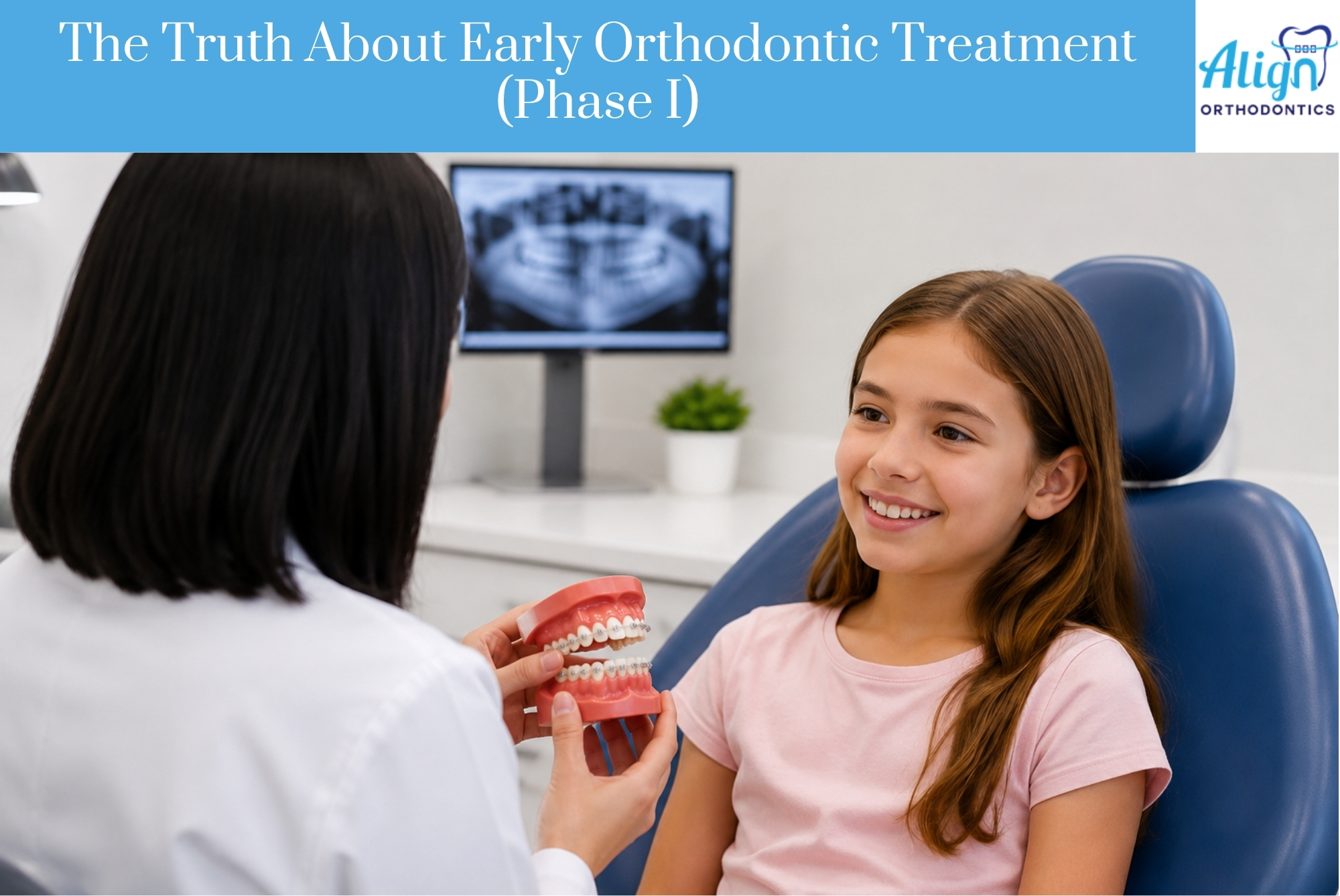
Parents often hear about “early orthodontic treatment,” “Phase I orthodontics,” or “two-phase orthodontic treatment” and wonder whether their child actually needs braces at a young age. Does starting orthodontic care early prevent bigger problems later? Is Phase I treatment necessary for every child? And how can parents tell when early intervention may be beneficial?
At Align Orthodontics Lexington, we believe parents should have clear, evidence-informed information before making decisions about their child’s orthodontic care. Early orthodontic treatment can be extremely valuable for certain developing bite, jaw, and tooth-position problems, but it is not appropriate or necessary for every child.
The purpose of Phase I orthodontics is not simply to straighten baby teeth or begin braces as early as possible. Instead, early treatment is typically recommended when addressing a specific problem during a child’s growth and dental development may improve function, guide development, reduce the severity of an orthodontic issue, or create better conditions for future treatment.
Here is what families should know about Phase I orthodontic treatment, including when an early orthodontic evaluation is recommended, which problems may benefit from intervention, what treatment can involve, and what happens afterward.
What Is Phase I Orthodontic Treatment?
Phase I orthodontic treatment, sometimes called early interceptive orthodontic treatment, is orthodontic care performed while a child still has a mixture of primary (baby) teeth and permanent teeth.
Rather than focusing exclusively on achieving the final alignment of all permanent teeth, Phase I treatment generally targets specific developmental concerns. Depending on the child’s needs, treatment may address tooth eruption, available space, bite relationships, jaw development, or other orthodontic problems.
After Phase I treatment is completed, there is commonly an observation period during which the remaining permanent teeth continue to erupt and the orthodontist monitors growth and dental development.
Some children later benefit from Phase II treatment after most or all permanent teeth have erupted. Others may require less extensive additional treatment depending on their development and the goals accomplished during Phase I.
At What Age Should a Child See an Orthodontist?
The American Association of Orthodontists recommends that children have an orthodontic check-up no later than age 7.
This does not mean every 7-year-old needs braces.
Around this age, enough permanent teeth have typically begun to emerge for an orthodontist to evaluate important aspects of dental and jaw development. An orthodontist can identify developing bite problems, crowding, abnormal eruption patterns, and jaw relationships that parents may not be able to recognize at home.
For many children, the best recommendation following an early evaluation is simply continued observation.
When treatment is not yet necessary, periodic orthodontic evaluations can allow the orthodontist to monitor development and recommend treatment at an appropriate time if a problem emerges.
Why Would a Child Need Orthodontic Treatment So Early?
Timing matters in orthodontics because a child’s teeth, jaws, and facial structures are still developing.
Certain orthodontic problems may be easier or more predictable to address while growth is occurring. In selected cases, waiting until all permanent teeth have erupted can allow a developing problem to become more pronounced or limit certain treatment options.
Early orthodontic treatment may be considered when an orthodontist identifies a condition that could benefit meaningfully from intervention during growth.
The decision should therefore be based on the individual child’s diagnosis rather than age alone.
What Problems Can Phase I Orthodontics Address?
Phase I orthodontics may be recommended for several different developmental concerns. The exact indications and treatment goals vary considerably from one child to another.
Crossbites
A crossbite occurs when certain upper teeth bite inside the lower teeth rather than outside them.
Crossbites can involve front or back teeth and may be associated with dental or skeletal discrepancies. In some children, a posterior crossbite may cause the lower jaw to shift to one side when biting.
An orthodontist can determine whether treatment during growth is appropriate based on the type and severity of the crossbite.
Significant Crowding
Crowding occurs when there is insufficient room for teeth to erupt into appropriate positions.
Early treatment does not necessarily eliminate future orthodontic treatment, but selected children with significant space problems may benefit from interventions designed to manage available space or guide developing permanent teeth.
Protruding Front Teeth
Upper front teeth that project significantly forward may affect a child’s bite and appearance and can be more exposed to accidental injury.
An orthodontic evaluation can determine the cause of the protrusion and whether early intervention is appropriate.
Underbites
An underbite occurs when the lower front teeth sit ahead of the upper front teeth when the jaws are closed.
Underbites may have dental, skeletal, or combined causes. Because jaw growth can play an important role, early assessment is especially useful. Treatment recommendations depend on the child’s individual growth pattern and diagnosis.
Severe Overbites
An overbite describes the vertical overlap between the upper and lower front teeth. A certain amount of overlap is normal, but an excessive or deep bite can sometimes contribute to functional or dental concerns.
An orthodontist can evaluate whether intervention is needed and determine the most appropriate timing.
Abnormal Tooth Eruption
Permanent teeth do not always erupt where or when expected. Teeth may become blocked, erupt in unusual positions, or lack sufficient space.
Monitoring eruption is an important component of early orthodontic care because identifying an abnormal eruption pattern may allow the orthodontist to recommend treatment before the problem becomes more complicated.
Space Loss
Baby teeth help preserve space for developing permanent teeth. If a primary tooth is lost earlier than expected, neighboring teeth can sometimes shift into the available space.
Depending on the situation, an orthodontist may recommend monitoring or an appliance to help manage space.
Jaw Growth or Bite Discrepancies
Some children develop noticeable differences between the growth or position of their upper and lower jaws.
Growth-related orthodontic treatment is highly individualized. The child’s age, skeletal development, type of discrepancy, growth pattern, and severity of the problem all influence whether treatment is recommended.
What Happens During an Early Orthodontic Evaluation?
An early orthodontic consultation is primarily an opportunity to understand how a child’s teeth and jaws are developing.
At Align Orthodontics Lexington, an orthodontic assessment may involve evaluating tooth alignment, eruption patterns, bite relationships, available space, and jaw development. Appropriate diagnostic records may also be recommended depending on the child’s needs.
The goal is to answer an important question: Does this child have a problem that would benefit from treatment now, or is monitoring the better choice?
If no immediate treatment is indicated, the orthodontist may recommend observation as the child continues to grow.
Does Every Child Need Phase I Orthodontic Treatment?
No.
This is one of the most important facts parents should understand about early orthodontics.
An orthodontic evaluation by age 7 is recommended because it provides an opportunity to identify problems early—not because every child should begin treatment at that age.
Many children can be monitored until additional permanent teeth erupt and then begin comprehensive orthodontic treatment later.
Phase I treatment should have a specific purpose. An orthodontist should be able to explain what condition is being treated, why intervention is recommended at the child’s current developmental stage, and what the expected goals are.
Does Phase I Treatment Mean My Child Will Not Need Braces Later?
Not necessarily.
Phase I treatment and comprehensive orthodontic treatment have different objectives.
Early treatment generally focuses on a particular developmental problem. After Phase I, a child’s remaining permanent teeth and jaws continue to develop. Phase II treatment may later be recommended to achieve comprehensive alignment and establish the final bite.
For this reason, parents should not assume that Phase I treatment guarantees that braces or clear aligners will never be necessary later.
Instead, the value of early treatment should be judged according to the specific problem it is intended to address.
What Is Phase II Orthodontic Treatment?
Phase II is generally the comprehensive stage of orthodontic treatment that occurs after most or all permanent teeth have erupted.
Treatment may involve braces, clear aligners, or other orthodontic appliances depending on the patient’s diagnosis.
The objective is typically to establish appropriate alignment and bite relationships across the permanent dentition.
When Phase I has already addressed an important developmental concern, Phase II can build upon those earlier changes.
How Long Does Phase I Orthodontic Treatment Take?
There is no universal Phase I treatment timeline.
Treatment length depends on the child’s diagnosis, growth and development, the appliance being used, treatment objectives, and patient cooperation when removable appliances or other compliance-dependent therapies are involved.
After active Phase I treatment, children may enter an observation or retention period while additional permanent teeth erupt.
Your orthodontist can provide a more meaningful estimate after examining your child and determining what treatment, if any, is indicated.
What Appliances Are Used for Early Orthodontic Treatment?
Phase I orthodontics is not synonymous with traditional braces.
Depending on the orthodontic problem, early treatment may involve limited braces, expansion appliances, space-management appliances, removable appliances, retainers, or other orthodontic devices.
The appliance is selected according to the treatment objective rather than simply the child’s age.
Because children’s orthodontic problems vary substantially, parents should avoid assuming that an appliance recommended for another child will be appropriate for their own.
What Are the Potential Benefits of Early Orthodontic Treatment?
When appropriately recommended, early orthodontic intervention may provide several potential benefits.
Depending on the diagnosis, treatment may help correct certain crossbites, manage space for developing teeth, influence selected bite relationships during growth, guide eruption, reduce the severity of specific orthodontic problems, or improve dental function.
The potential benefit should always be considered in the context of the individual child’s condition.
More treatment is not automatically better treatment. The objective is to provide treatment when there is a meaningful reason to intervene.
Are There Disadvantages to Starting Orthodontic Treatment Too Early?
Beginning orthodontic treatment without a clear indication can result in unnecessary treatment time, additional appointments, increased costs, and a longer overall period during which a child must manage orthodontic appliances.
Children may also experience treatment fatigue if orthodontic care continues for many years.
This is another reason appropriate diagnosis and timing are so important.
A recommendation to monitor growth rather than immediately begin treatment can be a deliberate orthodontic strategy—not a lack of treatment.
How Do You Know Whether Phase I Treatment Is Worth It?
Parents should understand the specific goal before agreeing to early orthodontic treatment.
Useful questions include: What problem does my child have? What happens if we monitor it instead? Why is the current stage of growth or dental development important? What is Phase I expected to accomplish? Will additional treatment probably be needed later?
Clear answers to these questions can help families understand whether early intervention offers a meaningful advantage.
Why Growth and Timing Matter in Orthodontics
Orthodontic treatment is closely connected to biological development.
Permanent teeth erupt at different stages, and the upper and lower jaws continue changing throughout childhood and adolescence. Consequently, the ideal treatment window for one orthodontic problem may differ substantially from the ideal timing for another.
Starting earlier is therefore not inherently better.
The goal is appropriate treatment at an appropriate stage of development.
Early orthodontic evaluations allow orthodontists to identify problems that warrant intervention while avoiding unnecessary treatment in children who would benefit from waiting.
Signs Your Child May Benefit From an Orthodontic Evaluation
Parents do not need to diagnose orthodontic conditions themselves. However, certain observations may be good reasons to schedule an evaluation.
These can include visibly crowded or overlapping teeth, front teeth that protrude noticeably, difficulty biting or chewing, a bite that appears shifted to one side, upper teeth that sit inside the lower teeth, lower front teeth positioned ahead of upper front teeth, unusually early or late loss of baby teeth, or permanent teeth erupting in unexpected locations.
Even without an obvious problem, an orthodontic check-up around age 7 can provide useful information about development and future treatment needs.
Early Orthodontics Is About the Right Treatment at the Right Time
The truth about Phase I orthodontics is relatively simple: some children can benefit significantly from early treatment, while many others do not need immediate orthodontic intervention.
The purpose of an early evaluation is to distinguish between those situations.
When a developing orthodontic problem is identified, treatment at the right developmental stage may provide opportunities that are different from those available later. When intervention is unnecessary, careful monitoring allows growth and tooth eruption to continue without prematurely placing a child into treatment.
Parents in Lexington and surrounding Massachusetts communities who have questions about their child’s bite, tooth eruption, crowding, or jaw development can schedule an orthodontic evaluation with Align Orthodontics Lexington to receive recommendations based on their child’s individual needs.
Frequently Asked Questions About Phase I Orthodontic Treatment
What is Phase I orthodontic treatment?
Phase I orthodontic treatment is early orthodontic care typically provided while a child has both baby and permanent teeth. It is designed to address specific developmental orthodontic problems rather than simply straighten every tooth.
What age does Phase I orthodontic treatment usually begin?
The appropriate age depends on the condition being treated and the child’s dental and skeletal development. Children are recommended to receive an orthodontic evaluation by age 7, but an evaluation does not automatically mean treatment should begin at that age.
Does my 7-year-old need braces?
Not necessarily. Many 7-year-olds who receive orthodontic evaluations do not need immediate treatment. An orthodontist may recommend periodic monitoring until the child’s development reaches a more appropriate stage for treatment.
Why is age 7 recommended for an orthodontic evaluation?
By approximately age 7, children typically have a combination of baby and permanent teeth that allows an orthodontist to evaluate eruption, tooth spacing, bite relationships, and aspects of jaw development. This can help identify certain developing orthodontic problems before all permanent teeth have erupted.
Is Phase I orthodontic treatment medically necessary?
The need for treatment depends on the individual diagnosis. Phase I treatment may be recommended when an orthodontist believes intervening during growth or dental development offers a meaningful advantage. Not every child needs early orthodontic treatment.
What conditions might require early orthodontic treatment?
Potential indications can include certain crossbites, significant crowding or space problems, abnormal tooth eruption, protruding front teeth, underbites, severe bite discrepancies, and selected jaw-growth concerns. A clinical examination is necessary to determine whether treatment is appropriate.
Can early orthodontic treatment prevent braces later?
Phase I treatment does not guarantee that a child will avoid braces or clear aligners later. Some children still require Phase II comprehensive orthodontic treatment after their permanent teeth erupt.
What is the difference between Phase I and Phase II orthodontics?
Phase I generally addresses a specific developmental orthodontic concern while a child is growing and still has some primary teeth. Phase II usually occurs later and focuses on comprehensive alignment of the permanent teeth and establishment of the final bite.
How long is the break between Phase I and Phase II?
The observation period varies according to the child’s age, tooth eruption, growth, and orthodontic needs. The orthodontist may periodically evaluate the child during this interval to determine when—or whether—additional treatment is appropriate.
Are braces always used during Phase I treatment?
No. Phase I treatment may involve limited braces, expanders, removable appliances, space-management devices, retainers, or other orthodontic appliances. Treatment depends on the specific diagnosis and objective.
Can an orthodontist expand a child’s upper jaw?
Expansion appliances can be used for selected orthodontic and skeletal conditions in growing patients. Whether expansion is appropriate depends on the child’s anatomy, development, bite, and diagnosis. An orthodontic examination is necessary to determine whether an expander is indicated.
What happens if we wait instead of starting Phase I treatment?
That depends on the condition. Some problems can be safely monitored and treated later, while others may benefit from intervention during a particular developmental stage. Your orthodontist should explain the expected consequences and alternatives before treatment begins.
Is early orthodontic treatment painful?
Orthodontic appliances can cause temporary pressure, tenderness, or discomfort, particularly after placement or adjustment. Experiences vary by child and appliance. Families should contact their orthodontic office if discomfort is severe, persistent, or accompanied by an appliance problem.
Will Phase I treatment make Phase II shorter?
It can in certain cases, but it should not be assumed that Phase I will always shorten later treatment. The primary reason for early treatment should be to address a specific orthodontic problem at an advantageous developmental stage.
How do I know if my child’s teeth are too crowded?
Visible overlapping or teeth erupting outside the expected dental arch can suggest crowding, but appearance alone does not establish the severity or cause. An orthodontist can evaluate available space, eruption patterns, and developing permanent teeth.
Should I wait until my child’s dentist recommends an orthodontist?
Parents can schedule an orthodontic evaluation directly if they have concerns about their child’s teeth or bite. An evaluation by around age 7 is commonly recommended even when there is no obvious orthodontic problem.
Can thumb sucking or other oral habits affect orthodontic development?
Persistent oral habits can influence tooth position and bite development in some children. The effect depends on factors such as the type, frequency, intensity, and duration of the habit. An orthodontic evaluation can help determine whether a developing bite problem is present.
When should I be concerned about permanent teeth not coming in?
Tooth eruption varies among children, so differences in timing do not automatically indicate a problem. However, significant asymmetry, prolonged delays, or teeth appearing in unusual locations may warrant evaluation by a dental professional or orthodontist.
What should parents ask before agreeing to Phase I orthodontic treatment?
Ask what specific problem is being treated, why treatment is recommended now, what alternatives exist, what may happen without early intervention, how long treatment is expected to take, and whether Phase II treatment is anticipated. Understanding the objectives can help families make an informed decision.
Where can I schedule an early orthodontic evaluation in Lexington, MA?
Families can contact Align Orthodontics Lexington at (781) 860-7997, visit orthodonticslexington.com, or use the online appointment scheduling link below to request an orthodontic evaluation.
Contact Information
Align Orthodontics Lexington
57 Bedford St #120
Lexington, MA 02420
Phone: (781) 860-7997
Website: orthodonticslexington.com
Appointments: Schedule an Appointment